
- Paid
Last Mile GPON DSL Problem Analysis with Smarts CodeBook
Purpose
Smarts is used to analyze and identify root causes of network problems in DSL and GPON (PON) last-mile access networks, where traditional monitoring methods are ineffective due to passive infrastructure and complex cabling structures.
Problem Overview
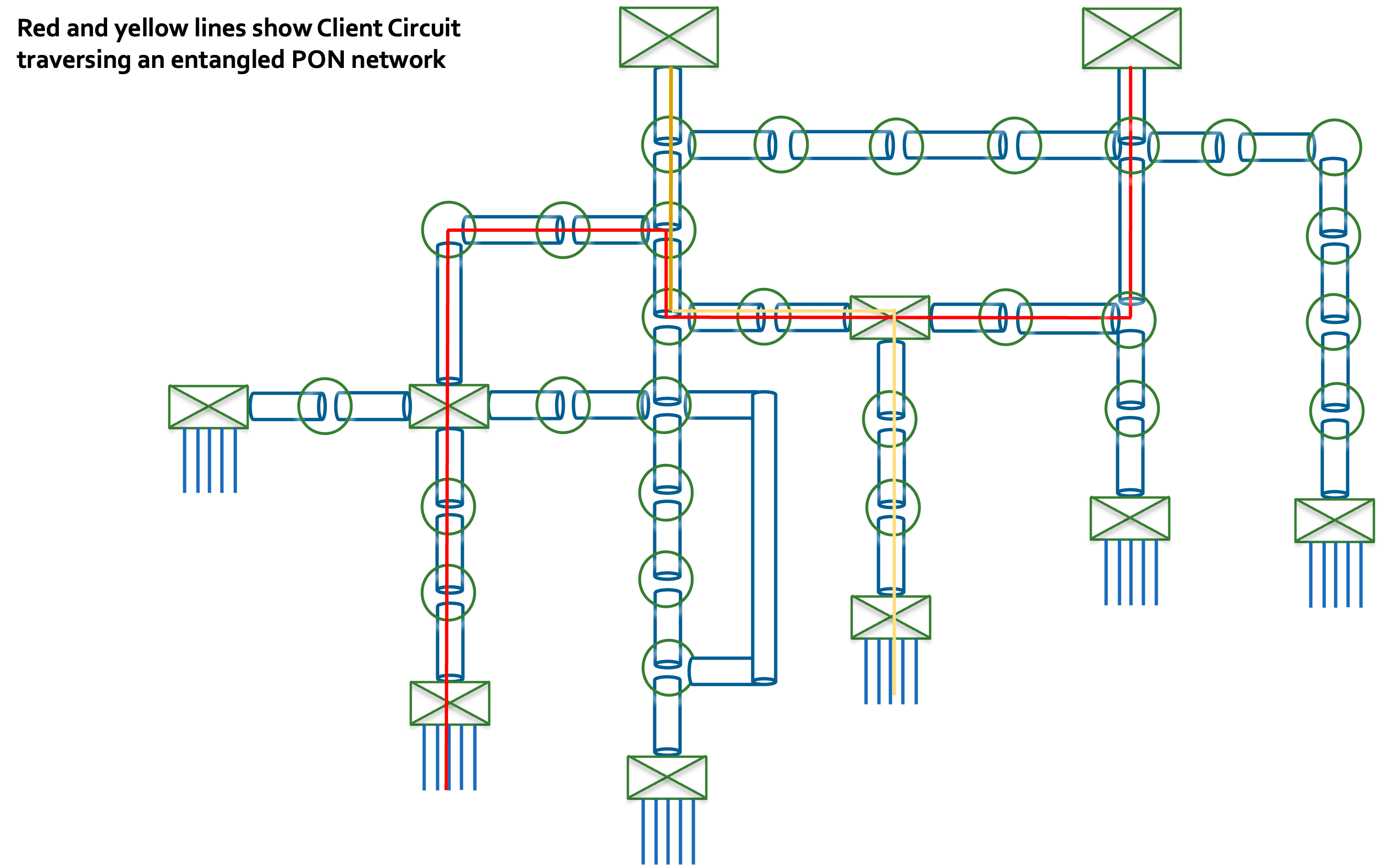
- Last-mile networks consist of massive numbers of cables, splices, and distribution frames.
- In theory, the topology forms a clean tree structure — but in reality, it’s entangled, with branches that reconnect or even service direction is sometimes reversed.
- Challenges:
- Difficult to locate the exact faulty cable segment.
- Vendor tools lack correlation capabilities.
- Passive optical cables cannot be directly monitored.
- A single fault may impact users dispersed throughout the network.
Smarts Solution Principles
- Since the passive network offers no direct monitoring, analytics rely on CPE (Customer Premises Equipment) data such as availability and performance.
- Root cause analysis must cope with topology complexity, which makes rule-based or suppression-type correlation engines useless.
- Smarts’ CodeBook correlation model is suitable because it defines all potential problems and their relationships (symptoms and causes) across topology objects.
Analytical Model in Smarts
- Defines relationships between:
- Client Circuits, Ports, Connection Points, Cable Segments, and Cables.
- Layers and dependencies modeled as N:M and N:1 relationships.
- Differentiates between:
- Monitored objects (e.g., ports, client circuits).
- Unmonitored objects (e.g., passive cables, splitters, distribution frames).
- Uses inheritance and layered-over relationships to propagate fault states through the topology.
Problem Definition Logic (CodeBook)
- Each analytical object has defined relationships and propagation rules.
- “Down” conditions are evaluated through correlated symptoms (e.g., circuits reported as unavailable).
- Competing “down problems” are compared by their explanatory strength — the one that best explains the observed symptoms is nominated as the root cause.
Examples and Correlation Scenarios
- Multiple client circuits report service unavailability.
- Faults in several cables (Cable 1, Cable 2, Cable 3) are candidates.
- The Smarts correlation model determines which cable’s fault best explains all affected circuits, designating it as the winning root cause.
- Complex test cases show that Smarts successfully correlates scattered service alarms into one accurate cable-level root cause.
Outcome
- Smarts’ CodeBook-based correlation allows automatic fault localization in complex last-mile environments without direct cable monitoring.
- It improves accuracy and efficiency of identifying faulty cable segments in DSL and PON networks — a task unachievable by vendor tools alone.
Features
Smarts is used to analyze and identify root causes of network problems in DSL and GPON (PON) last-mile access networks, where traditional monitoring methods are ineffective due to passive infrastructure and complex cabling structures.
- • Smarts CodeBook Correlation
- • Root Cause for passive networks
- • DSL Cable Network
- • PON Cable Network
- • Copper Cable Network
- • Last Mile Fiber Optics Network
- • DSLAM Monitoring
- • OLT/ONT Monitoring
- • Nokia/Alcatel MSAN
Integration Info
ProductsTelco Cloud Service Assurance (SMARTS)
Last Update02/01/2025